skip to main |
skip to sidebar
 The main reason for renovating Pomme gite was because of the staircase. The original staircase had been put in 'on a budget' and was a straight, open treaded pine staircase. You can see it behind the rocking chair on the left of the first picture. Because people often don't like open treaded staircases, the previous owner had nailed a piece of plyboard on the back. The problem with this is that the treads were not wide and now your feet could not poke through to the other side, making it feel even more like a ladder!
Very early on, we took off the piece of plyboard, but there was still a problem that where the stairs arrived on the top floor it was on the side the building under the sloping roof. The ceilings are very low and it meant having to bend over at an angle to step onto the upstairs floor. This was acceptable going up, but going down took a bit of getting used to.
Generally people like the gite, finding it cosy and full of character. However during the five years here, I have had two older clients who were not happy at all with the stairs, happily they were in quiet periods and I was able to re-house them in other gites.
The new stairs had to be made to measure, and my main aim was to have them arrive in the middle of the room upstairs, so that the sloping ceilings were not and issue. Stairs take up a lot of
  room downstairs, so the solution was to move them to one end of the gite and to turn through 90° twice to arrive at the top.
The stairs took about a week to install, the carpenters also built me a stairgate at the top, which I am really pleased with. They are made in a hardwood called Movingui, which is yellow/orange in colour. I experimented on scraps of wood with various stains and varnishes, and eventually decided that it was best with just a clear varnish (the upstairs photo shows the first coat of varnish on the left hand side).
I have two chimneys in my house, both lined with a stainless steel chimney liner. From time to time a bird comes down the tube and flies into the wood burner at the bottom, this is not a problem (so long as the fire's not lit!), I just open the windows in the room and open the wood burner and off goes the slightly puzzled bird.
The other day I woke up to hear noises to indicate that this had happened. I went downstairs, but could see no bird, so I pulled down the flue that covers most of the tube. After an hour or so I could hear the noises increasing, and out popped a Tawny Owl (Une chouette, which incidentally also means smart or great).
The owl was very sleepy (this being day time for humans and so night time for owls, I presume) and did not want to fly away.
After leaving it there for most of the day, I decided that I need ed to move it, so donned some thick gloves and put it in the wood shed. I thought that it would fly away during the night, but the following day it was still there, bearly moving. Oh dear, it was surely suffering from shock, my daughter wanted me to find a dead mouse to feed it, but not have too many dead mice in stock, I left it for another night. Happily it flew during the night and now I can hear it twit-t wooing in the oak tree in front of the house each night. I like happy endings!
Well I did it! It cost a lot of money, but its fantastic, mows and collects wet grass and you can empty the collecter without even getting off your seat!
It is so simple to use that my son, Hugh, mowed the lawn today
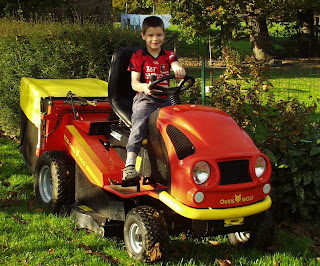
Hey, that's great, no more lawn mowing. As a single mum, I'm all in favour of child labour - hey look he can empty it, too!

One of my most important tools of my job is my lawn mower. I have over 1.5 hectares of land mostly laid to lawn and it takes me around 4.5 hours per week to keep the grass cut neatly. The tool for the job is a sit-on lawnmower with a cutting width of 120cm and three rotary blades. The cut grass can either be mulched by attaching a flap over the exit hole, which forces it back into the blades to be chopped up further and left on the lawn, or collected through a side mounted tube which throws the clippings up over the back of the mower into three collecting bins mounted at the back.
When I bought the mower they told me that it wasn't quite big enough for the size of the ground, but at 3,500 euros, I considered that it was within my budget, whereas the alternative started at 10,000 euros. Mistake!
I have been riddled with problems with this mower, drive belts breaking regularly, pulleys needing replacing, springs breaking. I think that (a) its not a brilliant machine (badged generic mower with Briggs and Stratton Engine) and the work that it does it just cannot cope with.
This weekend, after a short holiday away from the gites, I tried to mow - the battery was flat, so I jump started it from my car. I mowed for about 5 minutes and the blades cut out (after a bit of investigation, this was also due to no power in the battery. I charged the battery overnight, but no joy. I bought a new battery and charged it, then started to mow again. After 10 minutes, the secondary (but also important) drive belt for the mower bed snapped.
I managed to find another belt at my local lawn mower shop and I fitted it today -it took around 2 hours.
The main problem with my lawns is that they are sown on what was farm land, very well cultivated and heavily fertilised with nitrates during the 1970s, before the Agricultural control boards began to regulate the use of fertilizers. Nitrates promote green growth in plants, ie lots of grass!
Whilst I was in the lawn mower shop, they informed me that a customer who has 5 hectares of land around a lake had bought a Wolf A100K, a semi professional mower with ability to cut and collect wet grass. This customer has found that this model is not big enough for his land, so he wants to buy the next model up, he is selling his second hand 25hour usage mower for 8,000 euros. A lot of money, but one of the most important tools of my job.
I havent decided whether to buy or not yet, I can go and try the mower out first, then decide. I'll post the result.
 Moles are the a huge problem here at La Lohuas, especially this year. Normally they are active during the autumn winter and spring, but in the summer when the soil drys out and hardens, they become less active. This year has been fairly wet, so they have continued throughout the season. The little blighters have a capacity to create enormous mole hills, which leave big grassless patches in the lawn even if you scoop up the molehill. The hills also pose a problem to my lawn mower - they can be up to 50 cm in height and diameter, so quite damaging to the blades on the mower. This year I have spent half an hour collecting up the soil on just one lawn filling a big wheelbarrow to overflowing with mud. I am sure they are cute and furry (I haven't yet seen one here) but they add to my workload, so I'm afraid there is a war between us. Unfortunately, they are winning hands down!
Because of the size of the gardens here (2 hectaires or 4 acres) I cannot use any of the deterrant techniques, (solar noise generators, plastic bottles on sticks, mothballs down the holes, etc) as this just means that they move on to another area of the garden and I have more damage than before. So I am stuck with the option of eradication (kill them all!)
I have tried the following techniques:
Smoke cartridges - hah! they push up a mole hill with the spent cartridge sitting on the top
Water down the holes - nothing
Diesel down the holes (I know its not very environmentally friendly, but I was desperate) they move to another area.

A Détauper - this is a small explosive attached to a trigger that is plunged into the hole and when Mr Mole comes along he pushes up the trigger and if he's arrived from the right direction the explosive goes off under his tummy (awww, but it's quick and painless) This is very expensive and works very well, however my insurance does not cover me for explosive devices in the garden, when there are small children running around, so this has been put away for the winter.
Worm poisoning - probably the most effective without damaging the guests. I bought a box which contained a liquid (propylène glycol) and a powder (Chloralose). Here are the instructions on the packet (translation from French).
Preparing the bait: Find 250g of earthworms, pick them up just before you treat the moles, they must be fresh (the children and I dug for three hours and found 80 worms weighing a grand total of 22 grammes (ok fine, just divide the mixtures by 10))
Let them disgorge (empty) themselves for one hour in a clean container (ok, but some of them have already been here for 3 hours cause it took us that long to find all his friends!)
Dry them on kitchen towel - fine 80 worms spread on kitchen towel across the kitchen table (how hygenic)
Dowse them in propylene glycol - not explained on the packet, this kills them all - very quickly and very dramatically, luckily the kids, having lost interest, were watching TV at this point.
Cover them in the powder.
Find the tunnels: The principle tunnels start from a ditch, a hedge or a wall and go towards the centre of the lawn. Other tunnels will be secondary feeding tunnels, these have smaller mole hills. Only treat the principle tunnels ( my mole hills are all in the middle of the lawn and all large, maybe they're all principle ones)
Putting down the poison - Make holes in the tunnels between the mole hills without letting the soil fall into the tunnel (how do I know where the tunnels are - I have made several exploratory digs, but it seems that moles do not travel in straight lines between their molehills! - hey ho, I 'll just go straight under the molehill - if someone knows how to dig without the soil falling back into the hole, please let me know)
Put in 2 - 3 worms - they're all stuck together with the liquid and the powder, I mustn't touch them with my hands because moles dont like human odeur, so here I am with my little eyebrow plucking tweezers trying to separate the worms and drop them into the holes (whilst not displacing the soil)
Now clear away all the molehills, so you can see if you've succeeded (the easiest step, I've been doing this all year)
As they say in French " On n'a pas un metier facile" (not an easy job)

 Stairs take up a lot of
  room downstairs, so the solution was to move them to one end of the gite and to turn through 90° twice to arrive at the top.